Dog Vision Explained: What Your Dog Really Sees
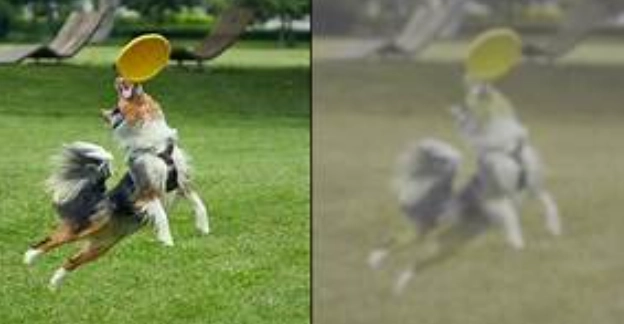
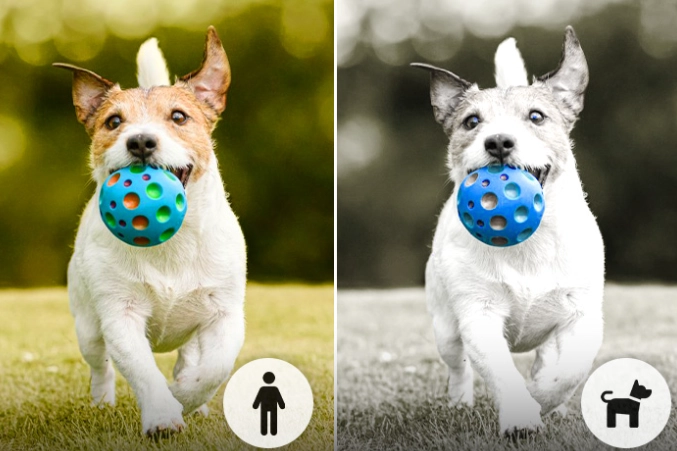
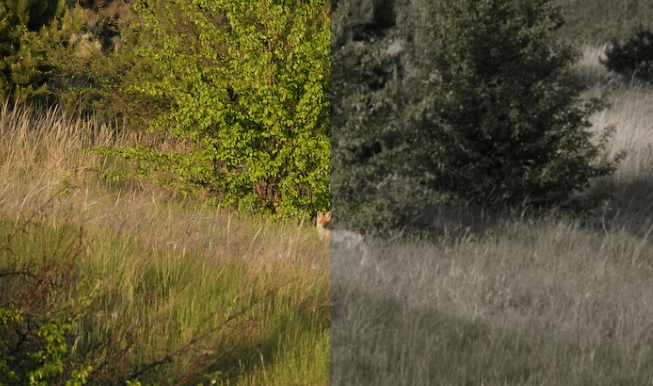
You throw a bright red ball onto the green grass. Your dog sniffs around, seems a bit confused, and then finally pounces on it after a moment's hesitation. Ever wonder why? The answer lies in understanding dog vision. It's not worse than ours, just profoundly different. Getting a handle on how your dog sees can transform everything from playtime and training to your overall bond. Let's break down the key components. If human vision is a high-definition color TV, dog vision is a highly sensitive motion-detection system with a specialized color filter. The biggest myth is that dogs see in black and white. That's just wrong. Research, like the foundational work by Jay Neitz at the University of Washington, shows dogs have dichromatic vision. They have two types of color-detecting cones (photoreceptors) in their eyes, while humans with normal vision have three. Here’s what that means in practice: A Common Mistake We All Make: We buy toys based on what looks vibrant to *us*. I spent years wondering why my dog was indifferent to a certain orange frisbee until I realized in his visual world, it likely blended into the dirt. The most engaging toys aren't the ones we find prettiest, but the ones that create the starkest contrast in *their* visual field. This is where dogs truly excel. Their eyes are built for low-light hunting. They don't see in pitch black—no animal can without a light source—but they need far less ambient light than we do to navigate confidently. That midnight bathroom trip your dog makes without bumping into walls? Thank the tapetum. This is arguably the most critical aspect of dog vision from a behavioral standpoint. Dogs are wired to detect the slightest movement. It's a survival trait. Their retinas have a higher percentage of rods dedicated to sensing motion. Think about it: a squirrel freezing becomes nearly invisible, but the moment it twitches, your dog locks on. This explains why some dogs go crazy for laser pointers (though I strongly advise against them due to the frustration they cause) and why a well-timed hand signal during training can be more effective than a verbal cue alone. This isn't just academic. You can use this knowledge today. Forget the red toys. Here’s a simple guide: Leverage their strengths. Their vision affects daily life. There's more to the picture. Depending on the breed (head shape matters a lot), dogs have a wider peripheral vision than humans—around 240-270 degrees compared to our 180 degrees. This helped their ancestors spot prey or predators. The trade-off? Less binocular vision directly in front for precise depth perception. Most dogs are mildly nearsighted. Their visual acuity is estimated around 20/75. This means what a human with normal vision can see clearly at 75 feet, a dog needs to be 20 feet away to see with the same clarity. So, that frantic waving from across the football field? You're probably just a blurry figure. They identify you much sooner by your unique movement pattern and smell. A sighthound like a Greyhound has eyes set more to the sides for a phenomenal field of view to spot movement, while a brachycephalic breed like a Pug has more forward-facing eyes (better depth perception) but a much narrower field of view and often more vision problems due to their eye shape. Understanding these nuances helps explain breed-specific behaviors. A herding dog is obsessed with motion because it's wired to see and react to it. A scent hound relies less on vision and more on its nose, which is why it might have its head down all the time. The bottom line is this: by learning to see the world through your dog's eyes, you stop making assumptions based on your own human perspective. You start making better choices—from the toys you buy to the way you communicate. It deepens the connection because you're meeting them in their world, not just expecting them to fully understand yours. Next time you're playing fetch, grab the blue ball. Watch how much quicker and more confidently your dog finds it. That's the power of a little knowledge about dog vision.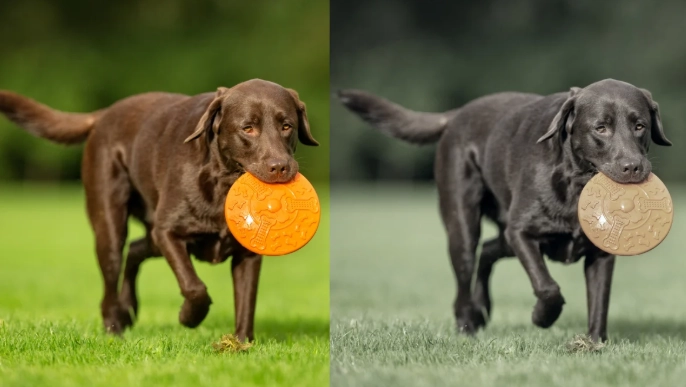
Quick Navigation: What's Inside
How Dog Vision Differs from Human Sight
The Color Debate: Not Black and White, But Blue and Yellow
Night Vision Champions
Motion Detection: Their Superpower
How to Use Dog Vision Knowledge for Better Training and Play
Choosing the Right Toys
Toy Color (Human Perception)
Dog's Likely Perception
Best For...
Worst For...
Blue
Vivid Blue
Fetch on grass, general high-visibility play
Hiding in shadowy areas
Yellow
Vivid Yellow
Fetch, indoor play on dark floors
Hiding in dry, yellowed grass
Red
Dark Brown/Gray
Contrast against light concrete or snow
Fetch on green grass or dirt
Green
Grayish-Yellow
Camouflage toys (for difficult find-it games)
Any game requiring quick spotting
Training and Communication
Home and Safety
Beyond the Basics: Field of View, Depth, and Acuity
Wider Field of View
Visual Acuity: They're Nearsighted
Breed Variations Matter

Your Dog Vision Questions Answered